
GTM Operating Model for SaaS: From Strategy to Weekly Execution
Most SaaS companies have a go-to-market strategy. Slide decks define the ICP. Spreadsheets model the funnel. Quarterly planning sessions set targets. Then the quarter starts, and the GTM operating model reduces to a collection of disconnected teams running their own playbooks with no shared system connecting strategy to weekly decisions.
The gap is not strategy. It is operating design. A GTM operating model is the system that converts strategic intent into repeatable, cross-functional execution. It defines who owns each stage of revenue creation, how handoffs work between marketing, sales, and customer success, what metrics each function is accountable for, and how the team reviews performance at a cadence that allows intervention before the quarter ends. Without this layer, strategy stays abstract and execution stays fragmented.
This guide walks through the architecture of a GTM operating model that SaaS teams can build and run in 30 days. Every element is designed to be operational, not theoretical.
Why Most GTM Models Fail Before Execution
GTM models fail for structural reasons, not effort reasons. The three most common failure patterns share a root cause: the model was designed for alignment meetings, not for operating decisions.
Failure 1: Strategy Without Ownership
The GTM plan defines segments, channels, and target metrics. But it does not assign explicit owners to each stage of the revenue lifecycle. When a lead stalls between marketing qualification and sales acceptance, nobody is accountable for the gap. The metric declines. The team notices it three weeks later in a pipeline review. By then, the quarter is already behind.
Failure 2: Metrics Without Decision Rules
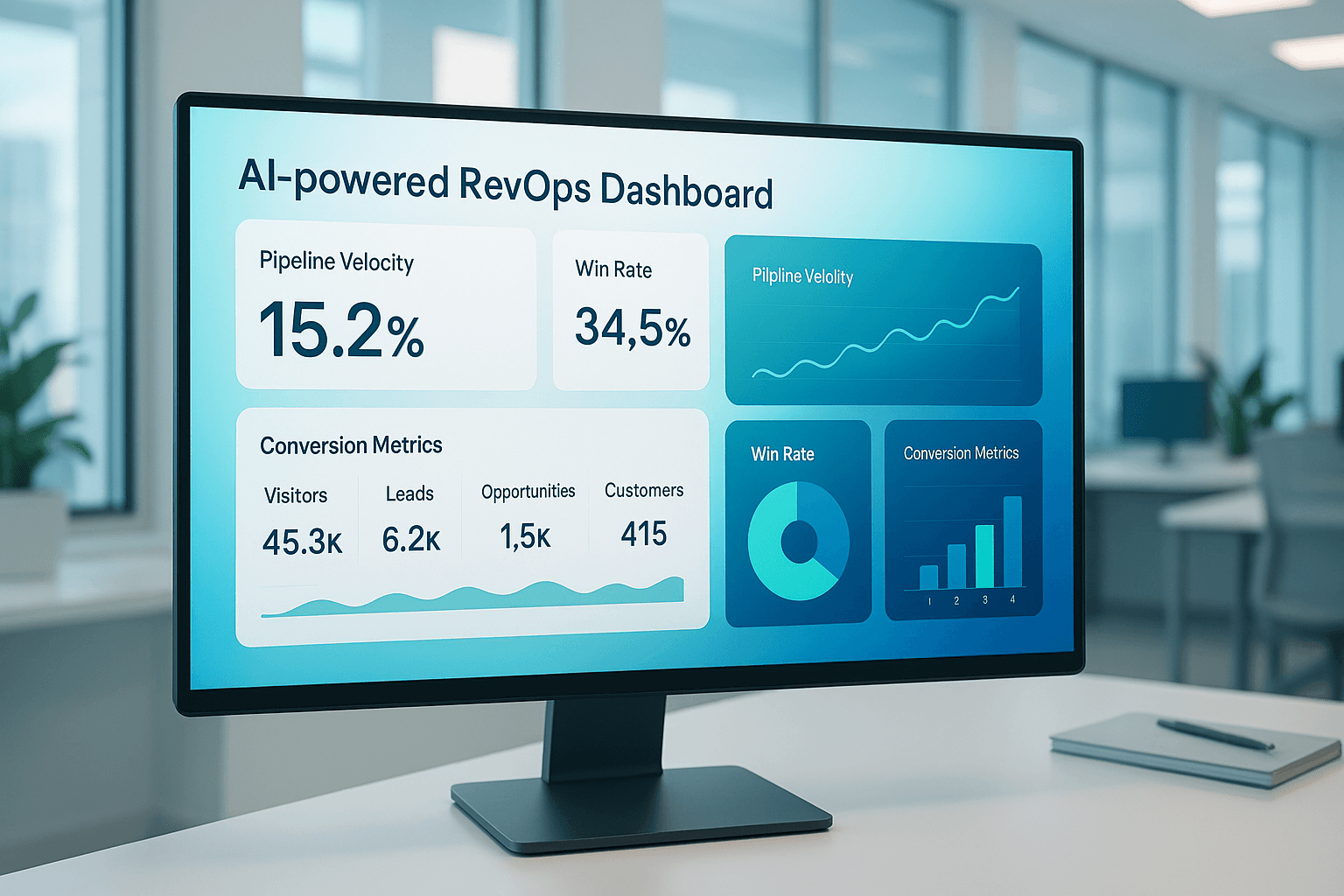
Dashboards display conversion rates, pipeline velocity, and win rates. But the operating model does not specify what action to take when stage-to-stage conversion drops below threshold. A metric without a decision rule is a report, not an operating signal. Teams monitor instead of intervene.
Failure 3: Cadence Without Authority
Weekly meetings exist. But the people in the room lack the authority to change process, reallocate resources, or escalate blockers. The cadence becomes a status update ritual instead of a decision-making system. Revenue Architects and Winning by Design have documented this pattern extensively. The solution is not more meetings. It is clearer decision rights attached to specific operating rhythms.
Each of these failures is fixable. But fixing them requires treating the GTM operating model as an operational system, not a strategic document.
The Five Layers of a Working GTM Operating Model
A functional GTM operating model has five layers. Each layer depends on the one below it. Skip a layer and the model develops blind spots that compound over time.
| Layer | Purpose | Output |
|---|---|---|
| 1. Revenue Architecture | Define the end-to-end revenue lifecycle | Stage map from first touch to expansion |
| 2. Ownership Map | Assign explicit owners to each stage and handoff | RACI matrix with SLA definitions |
| 3. KPI Architecture | Tie each stage to leading and lagging indicators | Metric tree with thresholds and decision rules |
| 4. Operating Cadence | Define review rhythms with decision authority | Weekly, monthly, and quarterly cadence map |
| 5. Feedback Loops | Connect downstream signals to upstream actions | Closed-loop reporting between CS, sales, and marketing |
Most SaaS teams have partial versions of layers one and three. They have a rough stage map and some dashboards. What they lack is the connective tissue: ownership maps that survive headcount changes, KPIs with explicit intervention triggers, and cadences where someone is authorized to act on what the data shows.
The advanced pipeline metrics framework covers Layer 3 in detail. This guide focuses on how all five layers connect into a single operating system.
Handoff Architecture: Where Revenue Leaks
Revenue does not leak inside functions. It leaks between them. The three critical handoffs in a SaaS GTM model are where the operating model either creates velocity or destroys it.
Handoff 1: Marketing to Sales (MQL to SQL)
The most common breakdown in SaaS GTM execution. Marketing generates leads against one set of criteria. Sales qualifies against a different set. The result is a conversion rate between 15% and 25% when it should be 35% to 45%. The fix is not better lead scoring. It is a shared definition of qualification criteria that both functions build together, documented as an SLA with response-time commitments.
- Define together: ICP fit criteria, engagement threshold, and required data fields before handoff
- SLA: Sales responds to qualified leads within four business hours
- Feedback loop: Sales reports disposition reasons weekly so marketing adjusts targeting
Handoff 2: Sales to Customer Success (Closed-Won to Onboarding)
A deal closes. The customer enters onboarding. But the context from the sales process does not transfer. Customer success rebuilds the relationship from scratch, re-asks discovery questions, and delays time-to-value by two to four weeks. The operating model must specify what data transfers at closed-won, who initiates the handoff meeting, and what the onboarding SLA looks like.
- Handoff packet: Use case, success criteria, decision-makers, technical requirements, and timeline commitments
- Warm handoff: Joint call between AE and CSM within 48 hours of closed-won
- SLA: First onboarding session scheduled within five business days
Handoff 3: Customer Success to Expansion (Retention to Upsell)
Expansion revenue depends on CS identifying expansion signals and routing them back to sales or an expansion team. Without a defined trigger and routing rule, upsell opportunities sit in CS notes and never reach a pipeline. The operating model defines what qualifies as an expansion signal, who owns the routing, and how it enters the pipeline.
Operating principle:
Every handoff needs three elements: a trigger condition, a data packet, and a response-time SLA. If any element is missing, the handoff is a suggestion, not a process.
KPI Architecture That Drives Decisions
A GTM operating model requires a KPI architecture that separates leading indicators from lagging indicators and attaches decision rules to each. Most teams track revenue, pipeline value, and win rate. These are lagging indicators. They tell you what happened. They cannot tell you what to do next week.
Leading Indicators by Function
| Function | Leading Indicator | Decision Rule |
|---|---|---|
| Marketing | MQL-to-SQL conversion rate | Below 30%: audit qualification criteria with sales |
| Marketing | Pipeline contribution ratio | Below 40% of new pipeline: increase demand gen investment |
| Sales | Stage-to-stage conversion (S1 to S3) | Below 25%: review discovery quality and deal qualification |
| Sales | Average deal age by stage | Above 2x median: flag for pipeline hygiene review |
| Customer Success | Time-to-value (days to first success milestone) | Above 30 days: escalate onboarding process review |
| Customer Success | Expansion signal rate | Below two signals per CSM per month: review account health scoring |
The critical design choice: Every leading indicator must have a threshold, an owner, and a specific action. "Monitor conversion rate" is not a decision rule. "If S1-to-S3 conversion drops below 25% for two consecutive weeks, the sales manager reviews the last 10 lost deals and presents findings at the weekly GTM standup" is a decision rule.
This is what separates a dashboard from an operating system. The revenue strategy blueprint builds this KPI architecture into a system your team can run from day one.
Operating Cadence: From Monthly Reviews to Weekly Execution
The cadence layer is where most GTM models break. Teams default to monthly pipeline reviews and quarterly business reviews. These cycles are too slow for intervention. By the time the monthly review surfaces a conversion drop, three weeks of pipeline have already leaked.
The Three-Tier Cadence Model
- Weekly GTM Standup (30 minutes): Cross-functional review of leading indicators only. Marketing, sales, and CS each present one metric against threshold. Any metric below threshold triggers a named owner and a one-week action item. No slide decks. No lagging metrics. This is an intervention meeting, not a reporting meeting.
- Biweekly Pipeline Review (60 minutes): Deal-level review of pipeline health. Focus on aging deals, stalled stages, and handoff compliance. The pipeline review is where deal-specific decisions happen: advance, escalate, or remove. Use stage-to-stage conversion data from the prior two weeks to validate pipeline quality.
- Monthly Operating Review (90 minutes): System-level review. Are the handoff SLAs working? Are the decision rules producing better outcomes? This is where the team adjusts the operating model itself. Update qualification criteria, revise thresholds, or reallocate resources between channels. This meeting requires a decision-maker with budget authority.
Cadence rule:
If your weekly standup cannot produce at least one concrete action item with a named owner and a deadline, the cadence is not operational. Redesign the agenda or change who is in the room.
Quarterly business reviews still have a role, but they become strategic planning sessions, not performance reviews. The weekly and biweekly cadences handle performance. The quarterly session handles direction: market shifts, product launches, segment changes, and resource allocation for the next quarter.
How to Build Your GTM Operating Model in 30 Days
Building a GTM operating model does not require a transformation initiative. It requires four focused weeks with clear deliverables.
Week 1: Map the Revenue Lifecycle
Document every stage from first touch to expansion. Interview one representative from marketing, sales, and CS. Ask each: "What are the stages in your process? Where do you hand off to another team? What information do you need at the point of handoff? Where do things break?" Map the answers into a single lifecycle diagram. Disagreements between teams are the most valuable output of this week. They reveal where the operating model has gaps.
Week 2: Define Ownership and SLAs
For each stage and handoff, assign an owner. Define the SLA: response time, data requirements, and escalation path. The most common pushback is "we all own this." That is the same as nobody owns it. Every stage needs one accountable person. Use a RACI format: Responsible (does the work), Accountable (makes the call), Consulted (gives input), Informed (gets updated).
Week 3: Build the KPI Tree and Decision Rules
Select two leading indicators per function. Define the threshold for each. Write the decision rule: what happens when the metric crosses the threshold, who acts, and what the expected response time is. Do not try to measure everything. Six leading indicators with clear decision rules will outperform 30 dashboard metrics with no action plan.
Week 4: Launch the Cadence
Run the first weekly GTM standup. Use the leading indicators from Week 3. Assign a facilitator who is not a function leader. The facilitator's job is to enforce the decision-rule format: metric, threshold status, action if below threshold, owner, deadline. After the first two weekly standups, gather feedback and adjust. The operating model is not a document. It is a running system that improves through use.
Implementation principle:
Ship a working operating model in 30 days, then iterate. A perfect model that launches in 90 days loses two quarters of execution. A functional model that launches in 30 days improves every week.
Stop Strategizing, Start Operating
A GTM operating model is not a strategy deck. It is the system that makes strategy executable. It defines who owns each stage of revenue creation, how handoffs transfer context and accountability, what metrics trigger intervention, and how the team reviews and adjusts at a cadence that keeps pace with pipeline movement.
The five layers are straightforward: revenue architecture, ownership map, KPI architecture, operating cadence, and feedback loops. Most SaaS teams already have fragments of each. The work is connecting them into a single system that runs weekly, not quarterly.
Start with the 30-day build. Map the lifecycle. Assign owners. Define six leading indicators with decision rules. Launch the weekly standup. After 30 days, you will have a functional GTM operating model. After 90 days of iteration, you will have a competitive advantage that no tool purchase can replicate.
OpsEthic's Revenue Strategy Blueprint builds this exact operating model for SaaS teams, including the KPI tree, ownership map, cadence design, and handoff SLAs tailored to your current team and stack.
If your GTM strategy exists in a slide deck but not in your weekly operating rhythm, the system is not running. Fix the operating layer and the strategy will finally move.